


The “Wild West” era of Artificial Intelligence has officially concluded. In 2026, the global community has moved from speculative ethical debates to the strict enforcement of legal frameworks. As AI systems integrate into critical infrastructure—from healthcare diagnostics to autonomous financial markets—governments are prioritizing safety, transparency, and human rights.
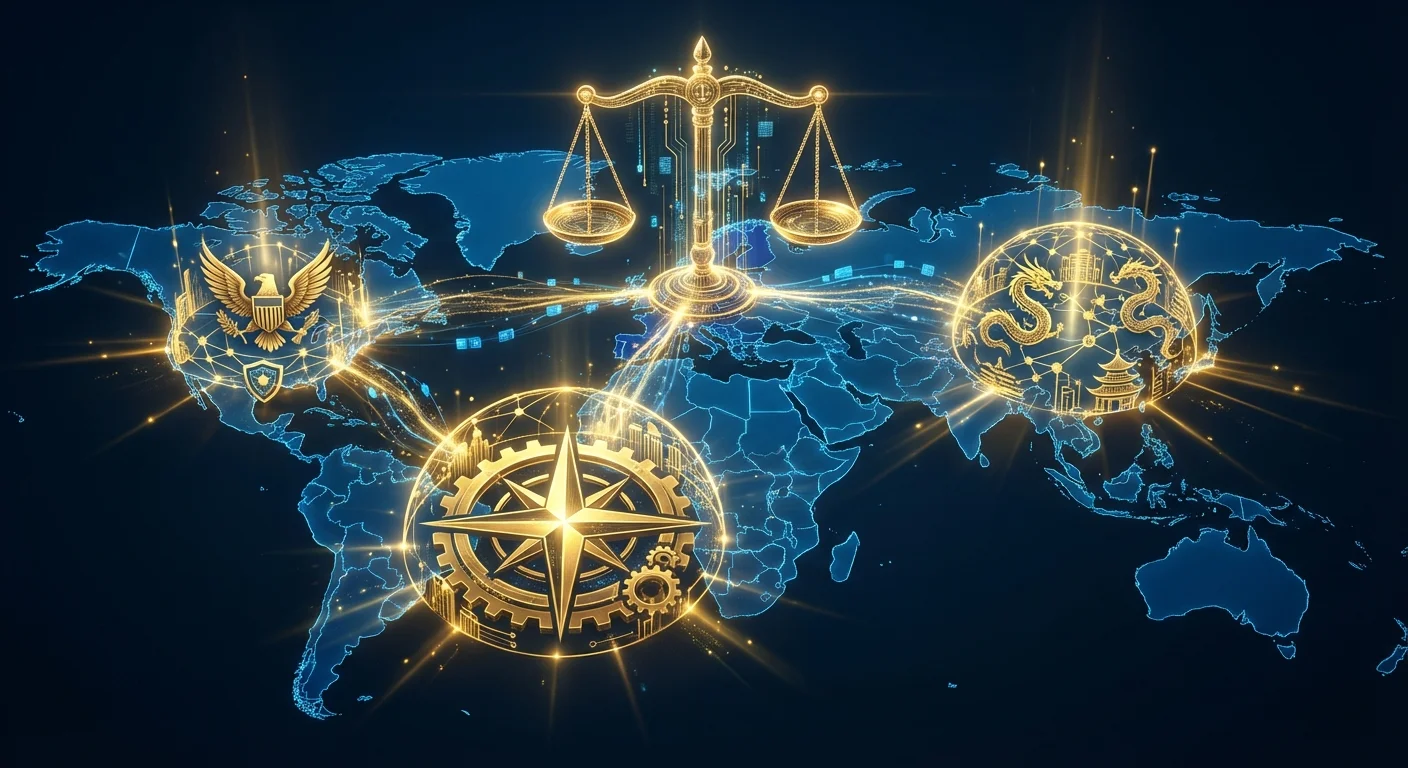
Understanding the latest AI Regulation Updates is no longer just a task for legal departments; it is a fundamental requirement for any organization deploying AI. This guide provides an exhaustive analysis of the landmark regulations shaping 2026, including the EU AI Act’s full implementation, new US federal mandates, and the emergence of “Sovereign AI” laws in Asia.

1. The Global Landscape: Why AI Regulation is Accelerating
The acceleration of AI Regulation Updates in 2026 is driven by three primary catalysts:
-
Systemic Risk: The rise of Agentic AI Systems that can execute multi-step actions autonomously.
-
Economic Protectionism: Ensuring that AI development aligns with national economic security.
-
Algorithmic Bias: Addressing the societal impact of biased models in hiring, lending, and law enforcement.
In 2026, compliance is the new competitive advantage. Companies that can prove their models are “Audited and Certified” are seeing higher adoption rates than those operating in regulatory “gray zones.”
2. The EU AI Act: Full Implementation and Enforcement
The European Union AI Act remains the world’s most influential framework, often referred to as the “GDPR of AI.” As of 2026, the grace periods have ended, and full enforcement is in effect.
Risk-Based Categorization
The EU framework classifies AI into four risk levels:
-
Unacceptable Risk: Social scoring systems and manipulative AI are strictly banned.
-
High Risk: AI used in critical infrastructure, education, and employment. These systems require mandatory “Conformity Assessments.”
-
Limited Risk: Systems like chatbots must meet strict “Transparency Obligations,” clearly informing users they are interacting with an AI.
-
Minimal Risk: Most AI applications (like spam filters) remain largely unregulated but are encouraged to follow voluntary codes of conduct.
The Rise of the “AI Office”
The European AI Office now conducts regular “Algorithmic Audits.” Failure to comply in 2026 can result in fines of up to 7% of a company’s global annual turnover, making AI Regulation Updates a top-tier financial risk.
-
ALT Text: A diagram illustrating the EU AI Act’s risk-based hierarchy for AI systems.
-
Description: A pyramid chart showing the four levels of risk defined by the European Union, with examples of prohibited and highly regulated AI applications.
3. United States: From Executive Orders to Federal Law
In 2026, the US approach to AI Regulation Updates has shifted from a fragmented state-by-step approach to a more cohesive federal strategy, following the milestones set by the NIST AI Risk Management Framework.
The AI Safety and Security Act of 2026
This landmark federal legislation requires developers of “Frontier Models” (models exceeding a specific computational threshold) to:
-
Perform Red-Teaming: Rigorous testing to ensure the model cannot be used to create biological or cyber weapons.
-
Report Compute Usage: Transparency regarding the massive hardware clusters used for training.
-
Watermarking: Mandatory digital watermarking for all AI-generated media to combat deepfakes and misinformation.
Sector-Specific Mandates
The SEC (Securities and Exchange Commission) and the FDA (Food and Drug Administration) have issued their own AI Regulation Updates. For instance, AI-driven medical devices must now undergo “Continuous Monitoring” post-launch to ensure no Neural Network Optimization leads to “Model Drift” that affects patient safety.
4. Asia-Pacific: Sovereignty and Ethical Innovation
Asia has emerged as a powerhouse of regulatory innovation in 2026, with a focus on balancing rapid growth with social stability.
China’s Generative AI Measures
China continues to lead in specific regulations for Generative AI. Their 2026 updates focus on “Content Veracity,” requiring that AI-generated content adheres to core socialist values and that all data used for training is “Legally Sourced and Factually Accurate.”
Singapore’s Model AI Governance Framework
Singapore has updated its Model Framework to include “Agentic Orchestration.” It provides a clear roadmap for businesses to implement Step-by-Step AI Implementation while ensuring human-in-the-loop oversight for high-stakes decisions.
See also
5. The Critical Pillar: Data Governance and Privacy
You cannot separate AI Regulation Updates from Data Governance Frameworks. In 2026, the focus is on “Data Provenance.”
The Right to Opt-Out of Training
New regulations in California (CCPA 2.0) and the UK now grant individuals the “Right to be Forgotten” from AI training sets. This means companies must have the technical ability to “unlearn” specific data points without retraining the entire model—a process known as Machine Unlearning.
Copyright and Intellectual Property
The courts in 2026 have established clear precedents. AI models that train on copyrighted material without a licensing agreement are subject to “Statutory Damages.” This has led to the rise of “Licensed Training Data” marketplaces, similar to stock photo agencies.
-
ALT Text: A technical map of data provenance and lineage for AI compliance.
-
Description: A visualization showing how data is tracked, cleaned, and governed before entering an AI model, ensuring regulatory auditability.
6. Technical Compliance: Transparency and Explainability
In 2026, “Black Box” AI is no longer legally defensible in high-stakes sectors. AI Regulation Updates now mandate Explainable AI (XAI).
-
Counterfactual Explanations: If a loan is denied by an AI, the system must provide a counterfactual: “If your income was $5,000 higher, your loan would have been approved.”
-
Model Cards: Every enterprise-level model must be accompanied by a “Model Card” detailing its training data, known biases, and performance limitations.
7. The Impact on Small Businesses and Open Source
A major point of contention in 2026 is the “Compliance Burden” on startups.
The Open Source Exemption?
The debate over whether Open Source AI Frameworks should be exempt from the strictest regulations continues. In the EU, open-source developers are generally exempt unless they are providing a model for commercial use in a high-risk category.
Compliance-as-a-Service (CaaS)
To help small businesses, a new market of “Compliance-as-a-Service” tools has emerged. These tools use AI to audit other AI systems, automatically generating the documentation required by the latest AI Regulation Updates.
8. AI Watermarking and the Fight Against Deepfakes
With the 2026 elections in various major economies, AI Regulation Updates have focused heavily on “Synthetic Content.”
-
C2PA Standards: Most social media platforms are now legally required to support the Coalition for Content Provenance and Authenticity (C2PA) standards, showing a “History” icon on any AI-altered image.
-
Liability for Platforms: Hosting providers are now liable if they fail to remove “Harmful Synthetic Media” (non-consensual deepfakes) within 24 hours of a report.
-
ALT Text: Example of a digital watermark and provenance label for AI-generated content.
-
Description: An interface showing how users can click an icon to see if a photo was generated by AI, which model was used, and if it was edited.
9. Implementing a Compliance Roadmap for 2026
For organizations navigating these AI Regulation Updates, the following Step-by-Step AI Implementation strategy is recommended:
-
Map Your AI Inventory: Know every model you use, whether it’s a third-party API or an in-house tool.
-
Conduct a Gap Analysis: Compare your current practices against the EU AI Act and local laws.
-
Appoint an AI Compliance Officer: This role bridges the gap between the CTO and the Legal Counsel.
-
Prioritize Transparency: When in doubt, disclose. Inform users when they are interacting with AI.
10. Conclusion: Toward a Trusted AI Future
The surge in AI Regulation Updates in 2026 might feel like a hurdle, but it is actually the foundation of a sustainable AI economy. Regulation provides the “Rules of the Road” that allow for innovation without chaos.
By embracing transparency, safety, and accountability, businesses can build products that are not only powerful but also trusted by the public. The future of AI belongs not to those who can build the fastest models, but to those who can build the most responsible ones. In 2026, ethics is no longer an option—it is the law.