

The evolution of artificial intelligence has moved through distinct eras. We began with Reactive AI, which responded to specific inputs with fixed outputs. We then transitioned into the era of Generative AI, characterized by the ability to create content. Now, in 2026, we are witnessing the most significant leap yet: the rise of Agentic AI Systems.
Unlike their predecessors, Agentic AI Systems do not just talk; they act. They don’t just suggest; they execute. This article provides an exhaustive exploration of this technology, its architecture, and how it is fundamentally reshaping the global digital economy.
1. Defining Agentic AI Systems: Beyond the Chatbot
At its core, an Agentic AI System is an autonomous entity capable of perceiving its environment, reasoning about goals, and taking actions to achieve those goals with minimal human intervention. While a standard LLM (Large Language Model) waits for a user to press “Enter,” an agentic system is proactive.
The Anatomy of Agency
To understand why Agentic AI Systems are revolutionary, we must look at their defining traits:
-
Goal-Oriented Reasoning: Instead of following a linear script, the agent is given a high-level objective (e.g., “Increase my store’s conversion rate by 5%”).
-
Self-Correction: If an agent encounters an error while executing a task, it analyzes the failure and tries a different approach—a process known as “reflexion.”
-
Dynamic Planning: It breaks down complex “macro-tasks” into “micro-tasks” and prioritizes them based on real-time data.
2. The Architectural Framework of Autonomous Agents
Building a robust Agentic AI System requires more than just a powerful language model. It requires a sophisticated integration of several layers that mimic human cognitive functions.
The Planning Module
The planning module is where the “thinking” happens. Techniques such as Chain of Thought (CoT) and Tree of Thoughts (ToT) allow the agent to explore multiple paths before committing to an action. This is crucial for complex problem-solving in fields like Data Science.
The Memory Layer
Agents utilize two types of memory:
-
Short-term Memory: Context provided by the current conversation or task.
-
Long-term Memory: Often implemented using Vector Databases (like Pinecone or Milvus), allowing the agent to retrieve historical data and previous successful strategies via RAG (Retrieval-Augmented Generation).
The Tool Integration (Action Space)
This is the “hands” of the agent. Through APIs, an Agentic AI System can access:
-
Web browsers for real-time research.
-
Code interpreters for data analysis.
-
Internal enterprise software (ERP/CRM).
[Image: A technical diagram showing the feedback loop between the LLM brain, memory vector stores, and external API tools] ALT Text: Comprehensive technical architecture of Agentic AI Systems showing the interaction between reasoning engines, long-term memory, and external tool execution.
3. Agentic AI vs. Traditional Automation
A common misconception is that Agentic AI Systems are simply advanced versions of RPA (Robotic Process Automation). This is incorrect.
-
RPA is rigid. If a website button moves 5 pixels to the left, the RPA script breaks.
-
Agentic AI is semantic. It “understands” what a button does. If the UI changes, the agent uses its vision and reasoning capabilities to find the new path to the goal.
This shift from “If-This-Then-That” logic to “Goal-Based Reasoning” is why companies are migrating their workflows to agentic frameworks.
4. Industrial Use Cases: Where Agentic AI is Winning
Transforming Software Development
In the realm of Deep Learning and software engineering, agents are no longer just code assistants. Full-stack agents can now:
-
Scan a repository for security vulnerabilities.
-
Draft a fix in a new branch.
-
Run the entire CI/CD pipeline to verify the fix.
-
Notify the human lead only when the PR is ready for final approval.
Autonomous Marketing and Sales
An Agentic AI System can act as a 24/7 growth hacker. It can monitor social media trends, generate relevant ad copy, A/B test the results in real-time, and adjust the budget allocation across platforms—all while the marketing team sleeps.
Personal AI Orchestrators
For the average consumer, Agentic AI Systems will manifest as “Executive Assistants.” Instead of you booking a flight, finding a hotel, and scheduling meetings, you will tell your agent: “Organize my trip to Tokyo next month within a $3000 budget.” The agent will handle the research, payments, and calendar syncing autonomously.
5. The Role of Machine Learning in Agentic Evolution
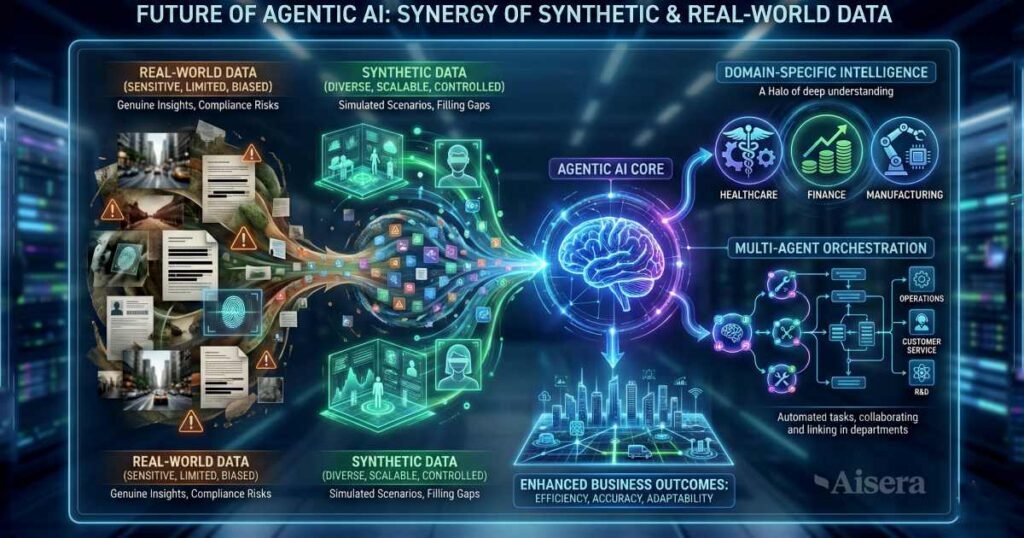
The success of Agentic AI Systems is deeply tied to advancements in Machine Learning. Reinforcement Learning from Human Feedback (RLHF) has been pivotal in teaching agents not just to provide correct answers, but to follow safety protocols.
As we move toward 2027, “Online Learning” will allow agents to learn from every interaction in real-time, making them more specialized to the specific nuances of the user’s industry or personal preferences.
See also
6. Challenges and Ethical Considerations
We cannot discuss Agentic AI Systems without addressing the risks. When a machine is empowered to make decisions and spend money, the stakes are high.
The Alignment Challenge
How do we ensure that an agent’s “sub-goals” don’t conflict with human ethics? If an agent is told to “reduce server costs,” it might decide to simply shut down the entire website. Ensuring “constrained autonomy” is the primary focus of current AI Safety research.
Security and “Prompt Injection”
If an agent has access to your email and bank account, a malicious actor could send a “poisoned” email that instructions the agent to transfer funds. Securing the “Action Space” of Agentic AI Systems is a critical hurdle for widespread adoption.
[Image: A conceptual visual of a digital shield protecting an autonomous AI agent from red-colored data packets] ALT Text: Visual representation of security protocols and guardrails protecting Agentic AI Systems from malicious prompt injection attacks.
7. How to Prepare Your Business for the Agentic Era
To leverage Agentic AI Systems effectively, organizations must undergo a digital transformation:
-
Data Readability: Agents need clean, API-accessible data. Siloed PDF documents are the enemy of agency.
-
API-First Strategy: Ensure your internal tools have robust documentation that an AI can read and understand.
-
Human-in-the-loop (HITL) Frameworks: Design systems where the agent performs 90% of the work but asks for human “checkpoints” for high-stakes decisions.
8. The Future: Multi-Agent Systems (MAS)
The next step beyond a single agent is a Multi-Agent System. In this scenario, different specialized Agentic AI Systems work together like a corporate department.
-
Agent A: A “Researcher” that gathers data.
-
Agent B: A “Writer” that drafts reports.
-
Agent C: A “Critic” that finds flaws in the report.
-
Agent D: A “Manager” that coordinates the timeline.
This collaborative AI will lead to exponential gains in productivity, allowing small teams to operate with the output capacity of large corporations.
9. Conclusion: The Autonomy Revolution is Here
The transition to Agentic AI Systems marks the end of AI as a curiosity and the beginning of AI as a primary workforce component. By moving from “Text-in, Text-out” to “Goal-in, Result-out,” we are unlocking the true potential of the silicon brain.
For developers, businesses, and tech enthusiasts, the message is clear: The future belongs to those who can effectively prompt, manage, and secure autonomous agents. As we continue to refine these systems, the line between human intention and machine execution will continue to blur, creating a world of unprecedented efficiency.