

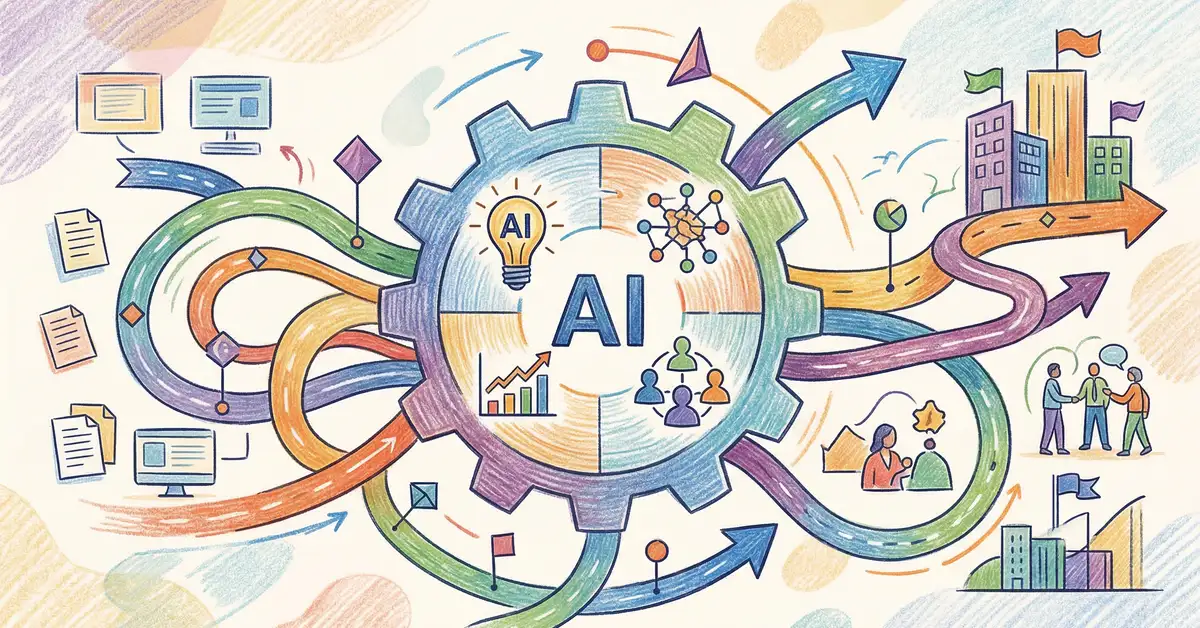
The conversation around Artificial Intelligence has shifted from “What is it?” to “How do we deploy it?” In 2026, AI is no longer a standalone experiment; it is a fundamental layer of the modern enterprise stack. However, despite the hype, many organizations struggle to move from a successful pilot to a full-scale rollout. The difference between a failed digital transformation and a revolutionary success lies in a structured, Step-by-Step AI Implementation strategy.
This guide provides a comprehensive, 10-stage framework for integrating AI into your business operations, ensuring scalability, security, and a clear Return on Investment (ROI).

1. Phase One: Strategic Alignment and Use-Case Identification
The most common cause of AI failure is “a solution looking for a problem.” Successful Step-by-Step AI Implementation begins with business logic, not technology.
Defining the Business Objective
Identify high-impact pain points. Are you looking to reduce customer service response times, optimize supply chain logistics, or automate repetitive financial reporting?
The Low-Hanging Fruit Strategy
For your first implementation, choose a “Low Complexity / High Value” project. This builds internal confidence and secures executive buy-in for larger, more complex initiatives. According to McKinsey’s 2026 AI Report, companies that start with targeted, narrow use cases are 3x more likely to successfully scale their AI infrastructure within 24 months.
2. Phase Two: Data Audit and Infrastructure Readiness
AI is only as good as the data that feeds it. You cannot skip the “Data Hygiene” step in a Step-by-Step AI Implementation.
The Data Inventory
Do you have the data required to train or prompt the model? Is it siloed in disconnected departments, or is it accessible via a centralized Vector Database?
Cleaning and Labeling
Data must be accurate, consistent, and free of bias. In 2026, organizations are increasingly using “Synthetic Data Generation” to fill gaps in their datasets without compromising user privacy.
-
ALT text: Data infrastructure audit stage of Step-by-Step AI Implementation.
-
Description: A technical diagram showing the flow of raw data from various departments into a unified, AI-ready data lake.
3. Phase Three: Choosing the Right AI Architecture
In 2026, the “One-Size-Fits-All” approach to AI is dead. You must decide which architectural path fits your specific needs.
-
Public LLMs (SaaS): Best for general productivity (e.g., OpenAI for Enterprise).
-
Private/On-Premise Models: Essential for highly regulated industries (Finance, Healthcare) where data cannot leave the internal network.
-
Retrieval-Augmented Generation (RAG): The standard for 2026. It combines a pre-trained model with your company’s private data to provide hyper-accurate, grounded responses.
4. Phase Four: The Pilot Program (Proof of Concept)
Never move directly to a company-wide rollout. A Step-by-Step AI Implementation requires a “Sandbox” environment.
Setting Key Performance Indicators (KPIs)
Before starting the pilot, define what success looks like.
-
Efficiency: A 30% reduction in ticket resolution time.
-
Accuracy: A 95% success rate in predictive maintenance alerts.
-
Cost: A 20% reduction in cloud compute overhead.
Selection of the Pilot Team
Choose a cross-functional team that includes both IT specialists and the “End-Users” who will actually use the tool daily. Their feedback is more valuable than any technical metric.
5. Phase Five: Ethical Frameworks and Governance
As you move through your Step-by-Step AI Implementation, you must address the “Trust Gap.“
Establishing an AI Ethics Board
This board is responsible for auditing the model for bias, ensuring transparency (Explainable AI), and maintaining compliance with global regulations like the EU AI Act.
Data Privacy and Security
Implement “Zero-Trust” protocols. Ensure that the AI has the “Minimum Viable Access” to your systems—it should only see the data it absolutely needs to perform its task.

See also
- The Crystal Ball of Data: Mastering Predictive Analytics Models in 2026
- The Backbone of Trust: A Definitive Guide to Data Governance Frameworks in 2026
6. Phase Six: Model Training, Tuning, and Integration
Once the pilot is successful, it’s time to refine the “Engine.“
Prompt Engineering and Fine-Tuning
While the base model is powerful, it needs to understand your company’s “Tone of Voice” and industry-specific jargon. This is achieved through systematic Prompt Engineering or fine-tuning open-source models like Llama 3.
API Orchestration
Integrate the AI into your existing software (CRM, ERP, Slack). In 2026, most businesses use Automated ML (AutoML) tools to manage these integrations seamlessly.
-
ALT text: Integration phase in Step-by-Step AI Implementation.
-
Description: A visualization of a cloud-based API bridge connecting a Large Language Model to a corporate database.
7. Phase Seven: Change Management and Employee Reskilling
Technology is easy; people are hard. A critical part of Step-by-Step AI Implementation is managing the human transition.
Alleviating “AI Anxiety”
Be transparent with your staff. Explain that the AI is there to remove “drudge work” (the boring, repetitive tasks), not to replace their roles.
The “Prompt-First” Culture
Invest in training. In 2026, “AI Literacy” is a required skill for every department. Host internal hackathons where employees find creative ways to use the new AI tools to solve their specific daily problems.
8. Phase Eight: Scaling and Full-Scale Rollout
With a successful pilot and a trained workforce, you are ready for “The Big Bang.“
Phased Rollout
Don’t turn everything on at once. Roll the AI out to one department at a time (e.g., Marketing, then HR, then Operations). This allows your IT team to handle the support load effectively.
Monitoring System Performance
Use Hardware Performance Comparison tools to monitor the load on your servers. If the AI is being used by 5,000 employees, you may need to scale your NPU (Neural Processing Unit) capacity.
9. Phase Nine: The Feedback Loop and Iterative Improvement
The final step in your Step-by-Step AI Implementation is never actually finished.
Performance Audits
Every 90 days, audit the AI. Is it still accurate? Is it suffering from “Model Drift”? Use the feedback from your employees to tweak the system.
ROI Assessment
Compare your initial KPIs against the actual results. Use this data to justify the budget for the next AI project.
-
ALT text: The iterative improvement cycle of Step-by-Step AI Implementation.
-
Description: A continuous loop diagram showing the stages of monitoring, feedback, retraining, and redeployment.
10. Phase Ten: Preparing for the Future (Agentic Workflows)
By 2027, the focus will shift from “Tools” to “Agents.” As part of your long-term Step-by-Step AI Implementation, start preparing for Agentic AI Systems. These are agents that can work together autonomously to complete multi-stage projects, such as designing a product, ordering materials, and managing the launch campaign with minimal human oversight.

11. Conclusion: The Competitive Advantage of Structure
The era of “Wait and See” is over. However, the era of “Rush and Fail” is also ending. The winners of 2026 are the organizations that approach AI with a disciplined, Step-by-Step AI Implementation strategy.
By focusing on data hygiene, ethical governance, and—most importantly—human reskilling, you turn AI from a buzzword into a permanent competitive advantage. Your AI journey is a marathon, not a sprint. Start with a solid foundation, and the technology will build the future for you.