

In the age of autonomous agents and decentralized intelligence, data has become the most valuable—and most volatile—asset an organization possesses. As we move through 2026, the challenge is no longer just collecting data, but ensuring its integrity, security, and ethical use. This is where Data Governance Frameworks become indispensable.
A robust framework is not merely a set of rules; it is a strategic architecture that aligns people, processes, and technology to turn “raw data” into “trusted intelligence.” This guide explores the evolution of data governance, the essential components of a modern framework, and how to implement one in the era of AI.
1. What is a Data Governance Framework?
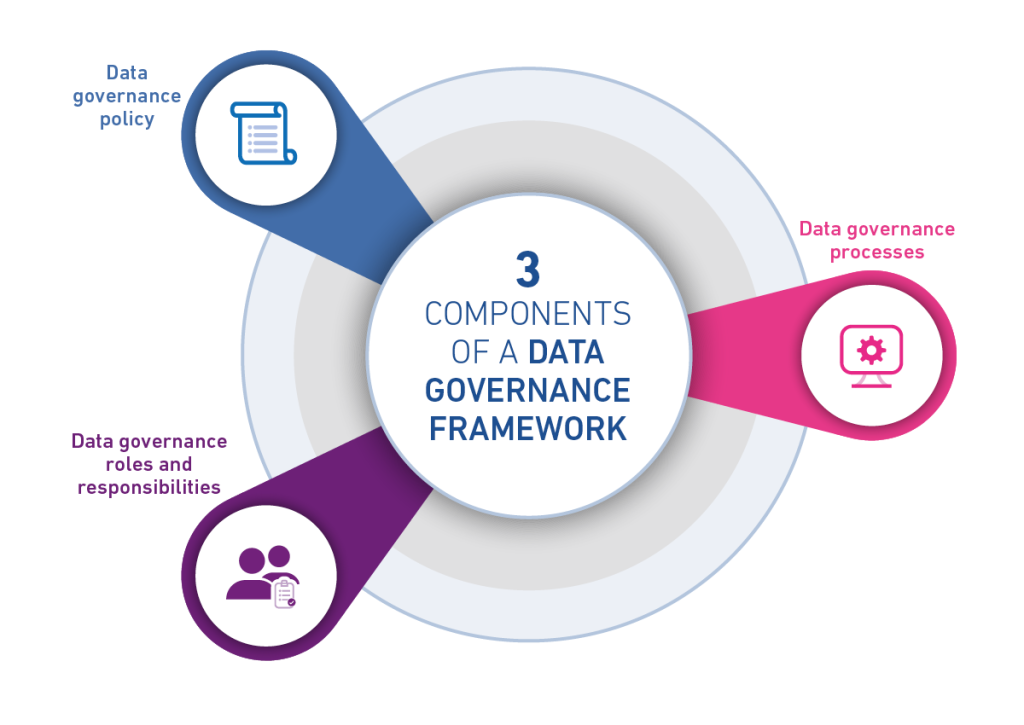
A Data Governance Framework is a holistic blueprint used by organizations to manage their data assets. It defines who can take what action, upon what data, in what situations, using what methods.
The Shift from Control to Enablement
Historically, governance was viewed as a “restrictive” function—focusing on locking data down. In 2026, the trend has shifted toward “Data Enablement.” Modern frameworks focus on making high-quality data accessible to the right people (and AI agents) at the right time, while maintaining strict compliance with global privacy laws.
2. The Core Components of Data Governance Frameworks
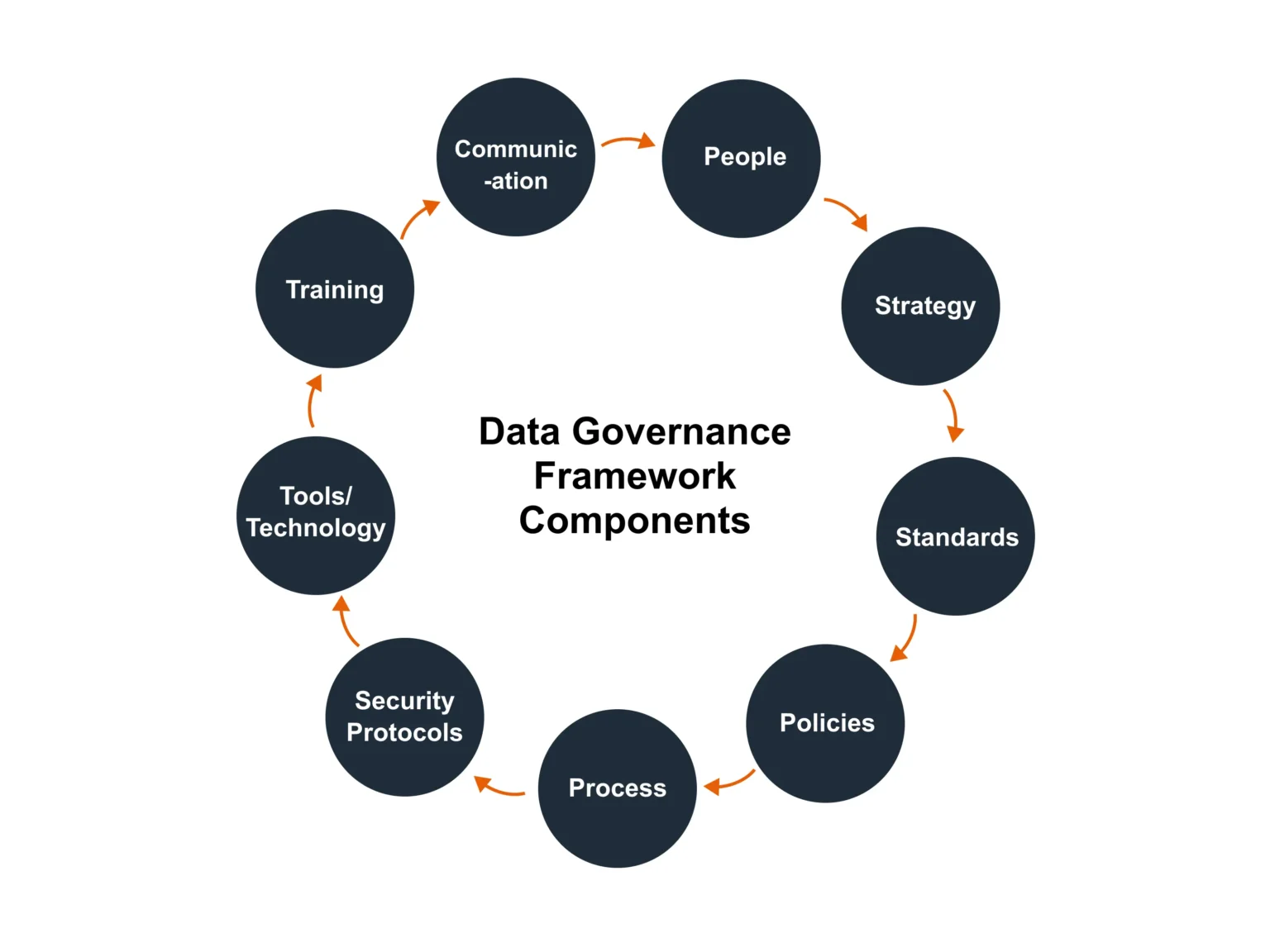
To be effective, Data Governance Frameworks must be built upon several foundational pillars. Without these, the framework is simply a document that gathers digital dust.
Data Stewardship and Ownership
Every data domain (e.g., Customer Data, Financial Data, Product Data) must have a designated owner. Data Stewards are the “boots on the ground” who ensure that data quality standards are met daily and that the data remains consistent across all platforms.
Data Quality Standards
Governance is meaningless if the data is inaccurate. Frameworks must define metrics for:
-
Accuracy: Is the data correct?
-
Completeness: Are there missing values?
-
Consistency: Is the same data represented identically across systems?
-
Timeliness: Is the data up to date for real-time decision-making?
Metadata Management
Metadata is “data about data.” A modern framework utilizes AI-powered Data Catalogs to automatically tag and categorize data, making it searchable and understandable for both humans and machines.
-
ALT Text: The core pillars of a modern Data Governance Framework including Quality, Stewardship, and Security.
-
Description: A structural diagram illustrating how different governance components support the overall data strategy of an enterprise.
3. Why Data Governance is Essential for AI Success
In 2026, you cannot have “Good AI” without “Good Data Governance.” The rise of Generative AI for Business has made governance a boardroom priority.
Preventing AI Hallucinations
If an AI model is trained on ungoverned, poor-quality data, it will produce “hallucinations”—confidently stating false information. A Data Governance Framework ensures that only verified, high-quality data reaches the AI training pipeline.
Model Lineage and Auditability
Regulators now require companies to explain how their AI models reached a specific decision. Effective governance provides “Data Lineage,” a clear map showing the origin of the data, how it was transformed, and which model utilized it.
4. Popular Data Governance Framework Models
Organizations don’t need to reinvent the wheel. Several established Data Governance Frameworks provide a starting point.
The DAMA-DMBOK Framework
The DAMA International Guide is the “Gold Standard.” It organizes data management into a “Wheel” of 11 functional areas, with Data Governance at the center.
The COBIT Framework
Developed by ISACA, COBIT focuses on the “Governance of Enterprise IT.” it is particularly effective for organizations that need to align their data strategy with strict financial and operational compliance.
The Data Governance Institute (DGI) Framework
The DGI model is highly regarded for its focus on the “People” aspect of governance, providing clear templates for organizational structures and decision-making bodies.
-
ALT Text: The DAMA-DMBOK framework illustrating the 11 functional areas of data management.
-
Description: A circular diagram showing how Data Governance acts as the central hub for all data-related activities.
See also
- The Velocity of Intelligence: A Master Guide to Real-time Data Processing in 2026
- The Efficiency Revolution: A Definitive Guide to Top Productivity AI Software in 2026
- Beyond the Black Box: The Ultimate Guide to Neural Network Optimization in 2026
5. Step-by-Step Implementation of a Governance Framework
Implementing Data Governance Frameworks is a marathon, not a sprint. Follow this 2026-optimized roadmap.
Stage 1: Assessment and Strategy
Begin by identifying the “Pain Points.” Is your marketing data messy? Are your financial reports inconsistent? Define the “Why” before the “How.”
Stage 2: Establishing the Governance Council
This body should include executive sponsors, IT leaders, and business unit heads. Their role is to set the high-level policies and resolve conflicts between different data owners.
Stage 3: Data Discovery and Classification
You cannot govern what you don’t know you have. Use Automated ML (AutoML) tools to scan your entire infrastructure and classify data based on sensitivity (e.g., Public, Internal, Confidential, Highly Restricted).
Stage 4: Defining Policies and Standards
Create clear, written rules for data access, retention, and deletion. In 2026, these policies must account for Edge Computing Trends, where data is processed locally on devices.
6. Technology’s Role: The Rise of “Active Governance”
The days of manual spreadsheets for governance are over. In 2026, we utilize Active Data Governance.
-
Automated Data Lineage: Software that automatically maps the flow of data across the enterprise.
-
Self-Healing Data: AI agents that identify a data quality issue (like a duplicate record) and fix it automatically based on governance rules.
-
Privacy-by-Design APIs: Developers now use Low-Code AI Development platforms that have governance rules “baked in” to the code, preventing data leaks at the source.
-
ALT Text: AI-powered dashboard for active Data Governance monitoring.
-
Description: A modern software interface showing real-time health scores for different data domains and automated lineage maps.
7. Overcoming the Challenges of Data Governance
Governance is often met with resistance. To succeed, you must navigate these hurdles:
The “Bureaucracy” Stigma
If governance feels like a “brake” on innovation, employees will find ways to bypass it. Data Governance Frameworks must be designed to accelerate work by providing a “Single Source of Truth.”
Data Silos
Different departments often “hoard” their data. Breaking down these silos requires a cultural shift from “My Data” to “Our Asset.”
Regulatory Complexity
With the EU AI Act and evolving GDPR standards, staying compliant is a moving target. Your framework must be flexible enough to adapt to new laws without requiring a complete overhaul.
8. Data Governance for the “Sovereign Edge”
In 2026, data localization laws are stricter than ever. Governments are demanding that citizen data remain within national borders. Data Governance Frameworks must now account for Data Sovereignty. This involves using Predictive Analytics Models to forecast where data should be stored to remain compliant while minimizing latency.
9. Measuring ROI: The Value of Governed Data
How do you prove the value of a Data Governance Framework to the CFO?
-
Cost Reduction: Fewer data storage redundancies and lower cloud compute costs.
-
Risk Mitigation: Avoiding the massive fines associated with data breaches and non-compliance.
-
Revenue Growth: High-quality data leads to better Step-by-Step AI Implementation, which in turn leads to more accurate marketing and higher sales conversions.

10. Conclusion: Data Governance is the Future of Business
We are living in an era where data is the lifeblood of the economy. However, without a structured approach, that lifeblood can quickly become a liability. Data Governance Frameworks provide the discipline required to turn the chaos of the “Big Data” era into the precision of the “AI Era.”
By investing in a framework that prioritizes quality, security, and ethics, you are not just checking a compliance box—you are building the foundation for a resilient, autonomous, and trusted enterprise.